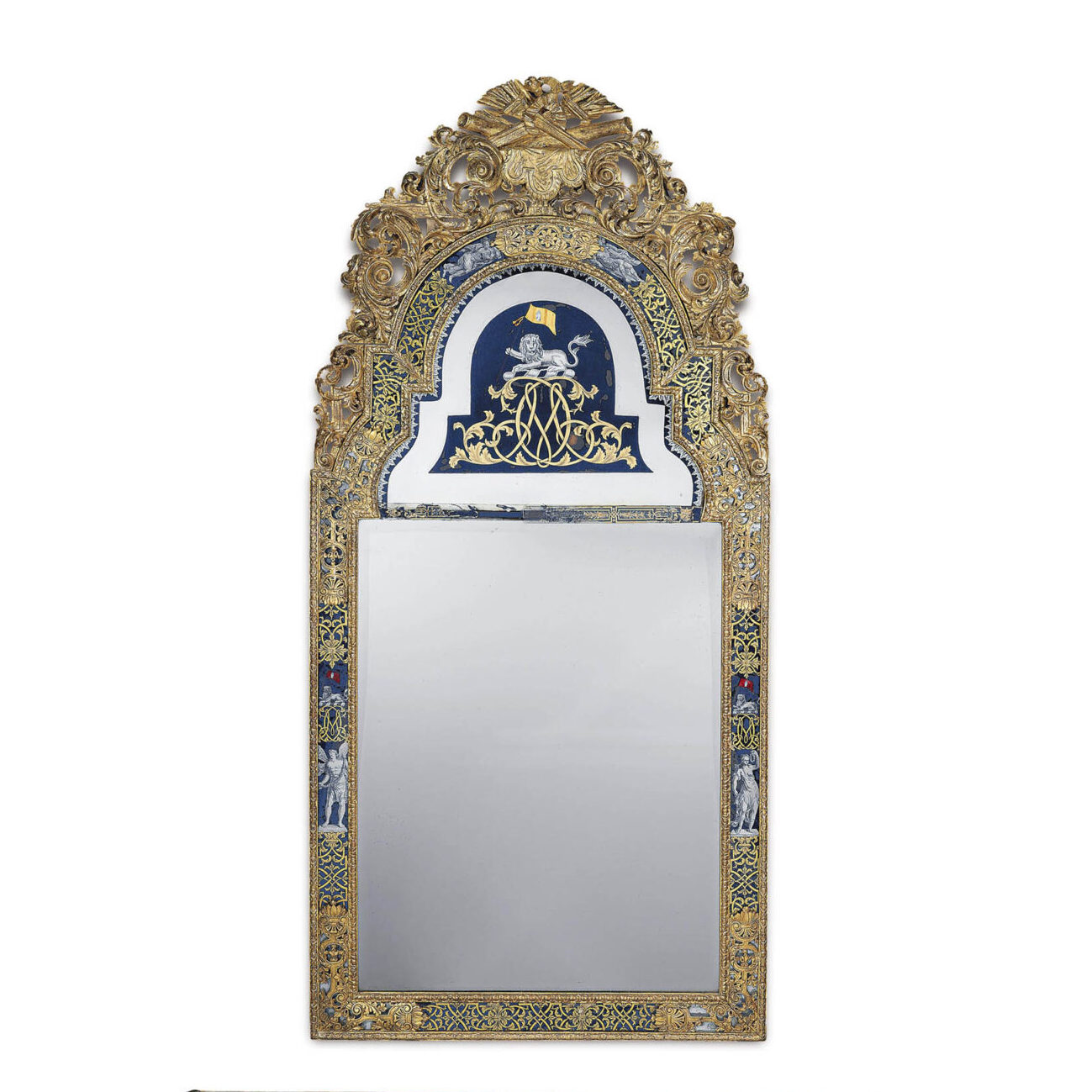
Antique Queen Anne Silver-Gilt Mirror or Pier Glass
£18,000
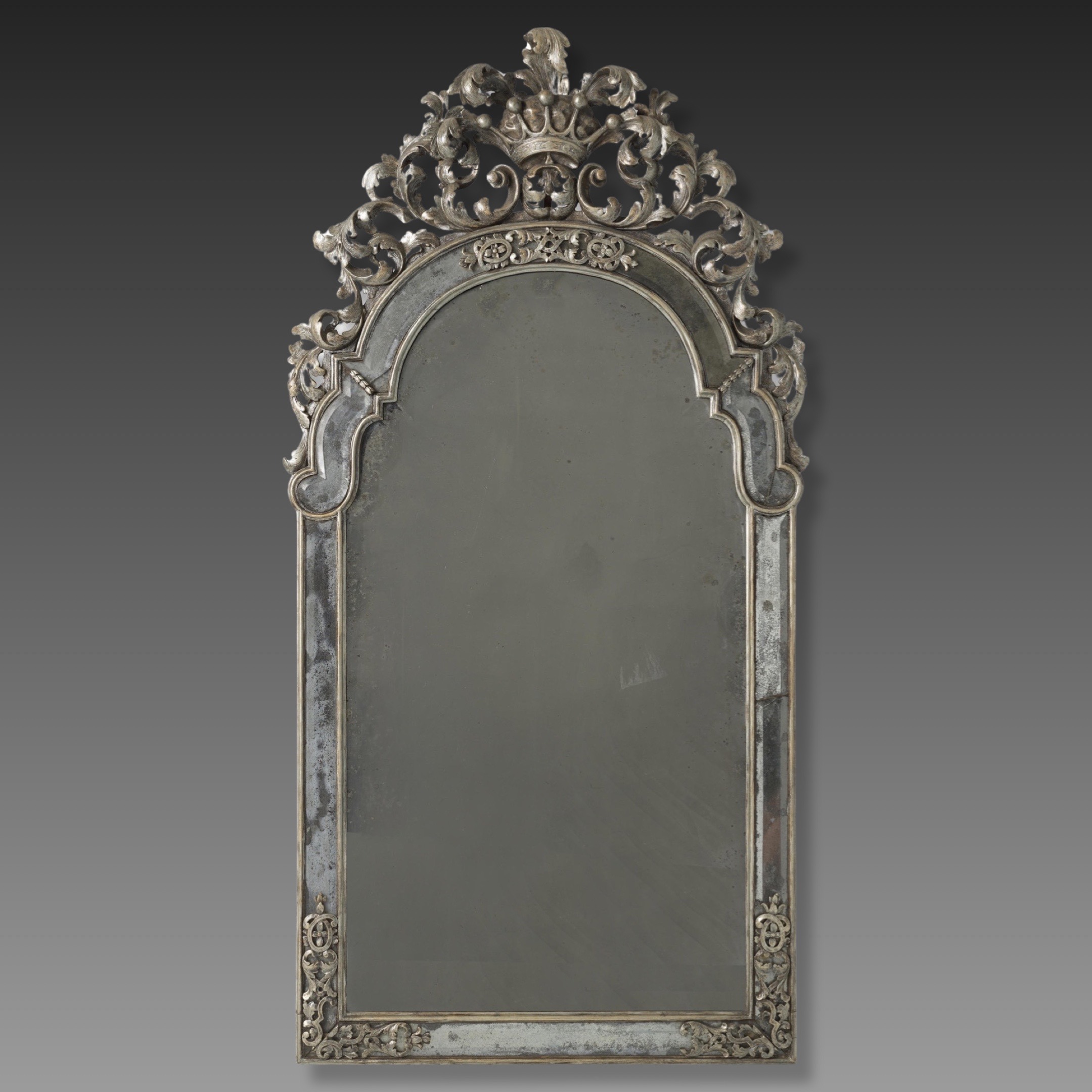
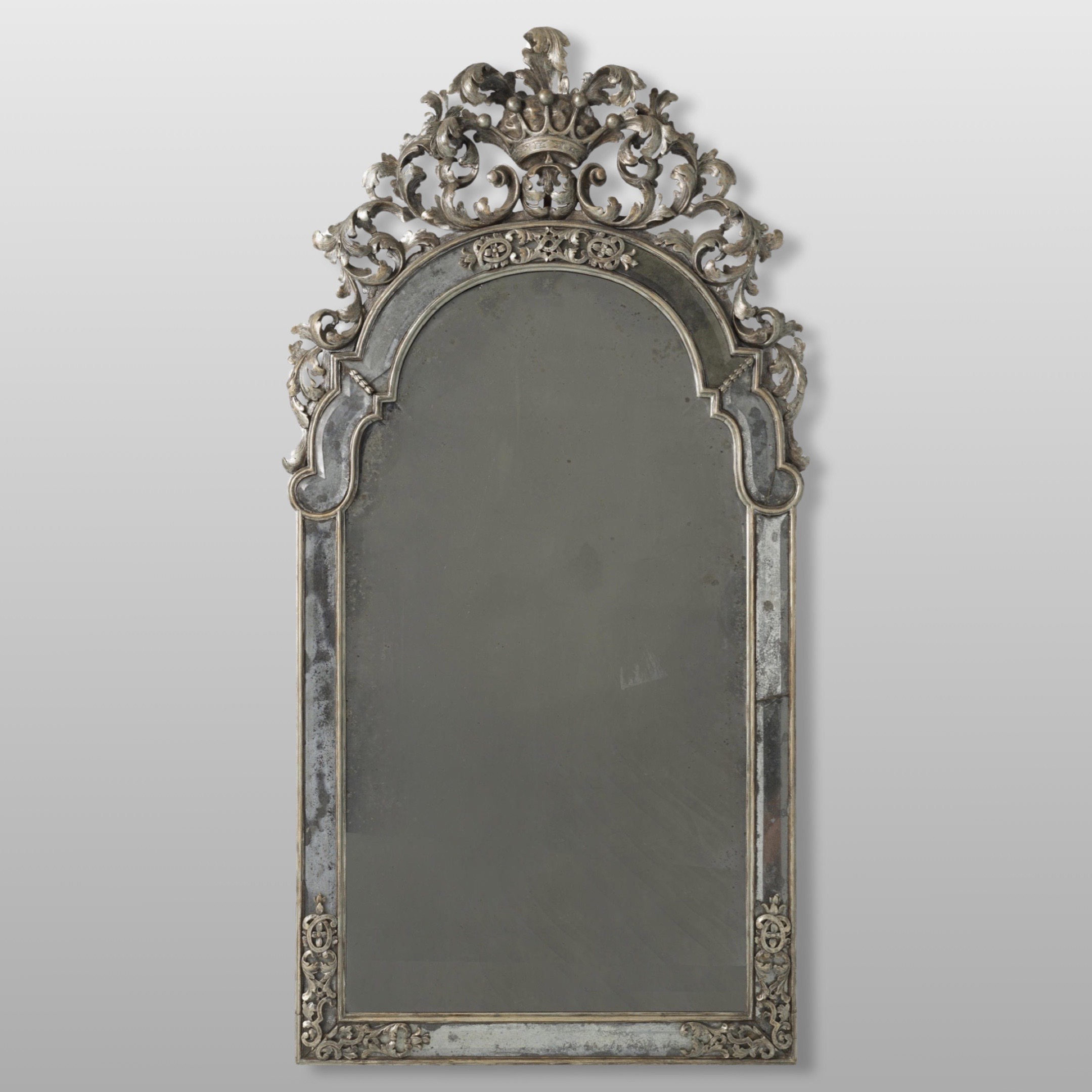
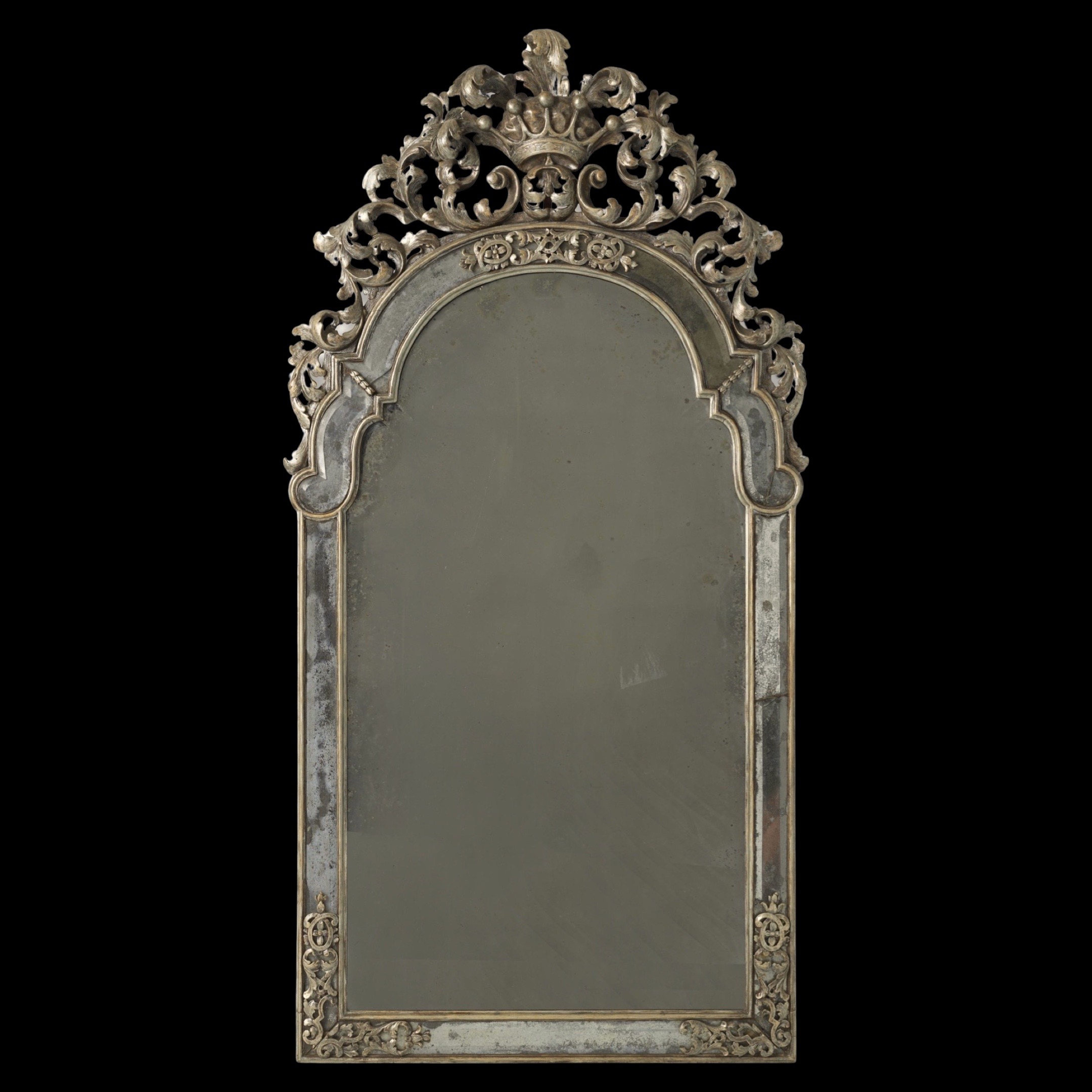
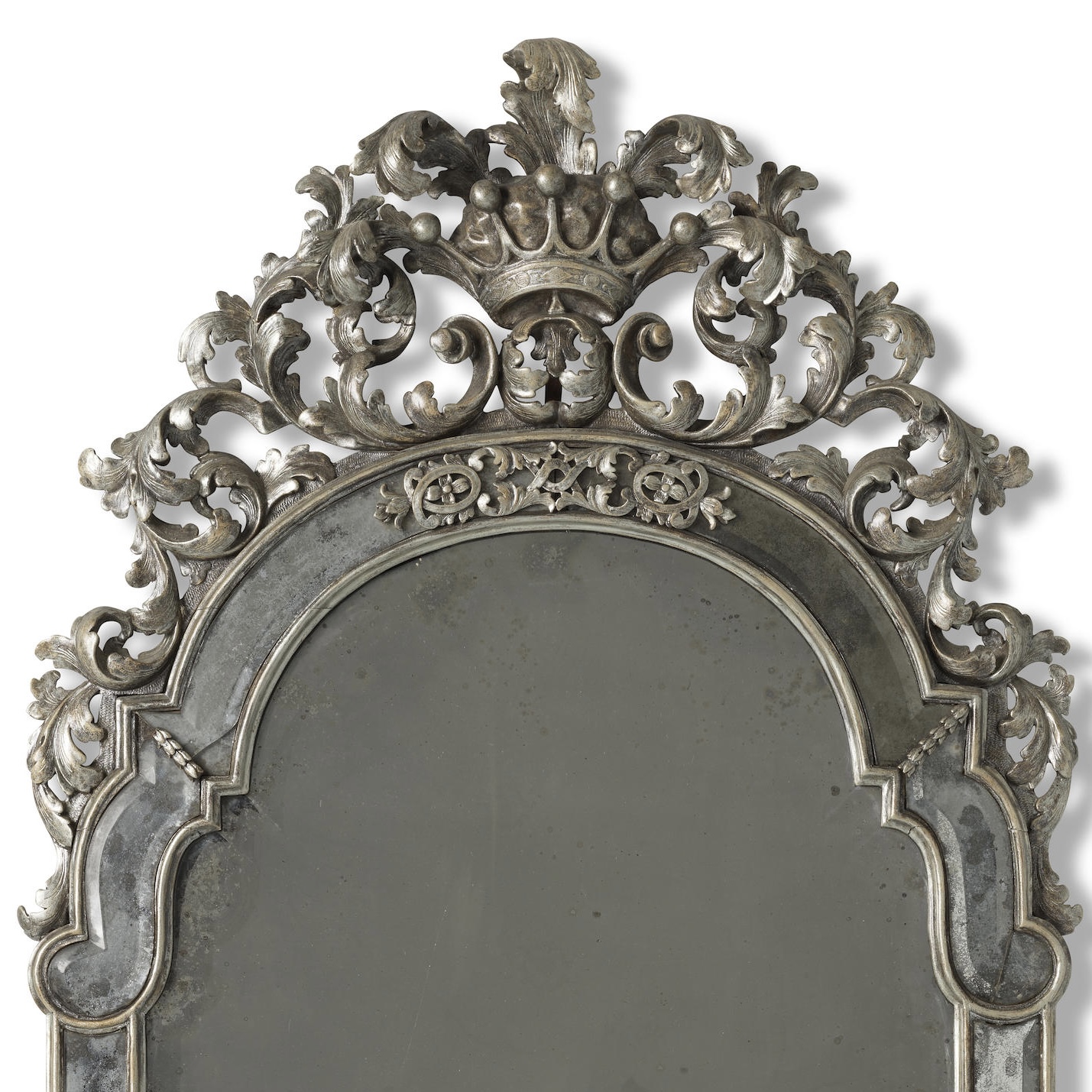
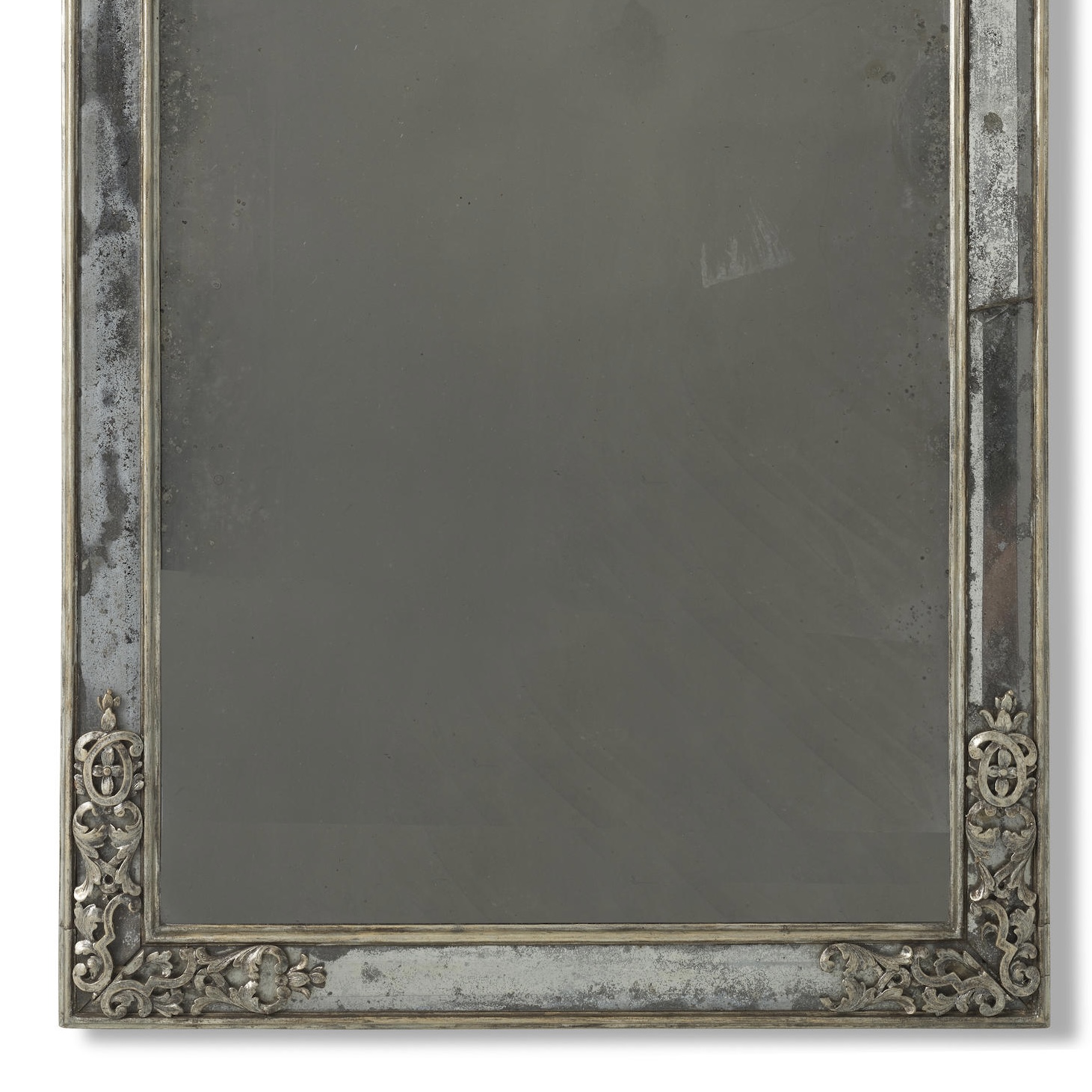
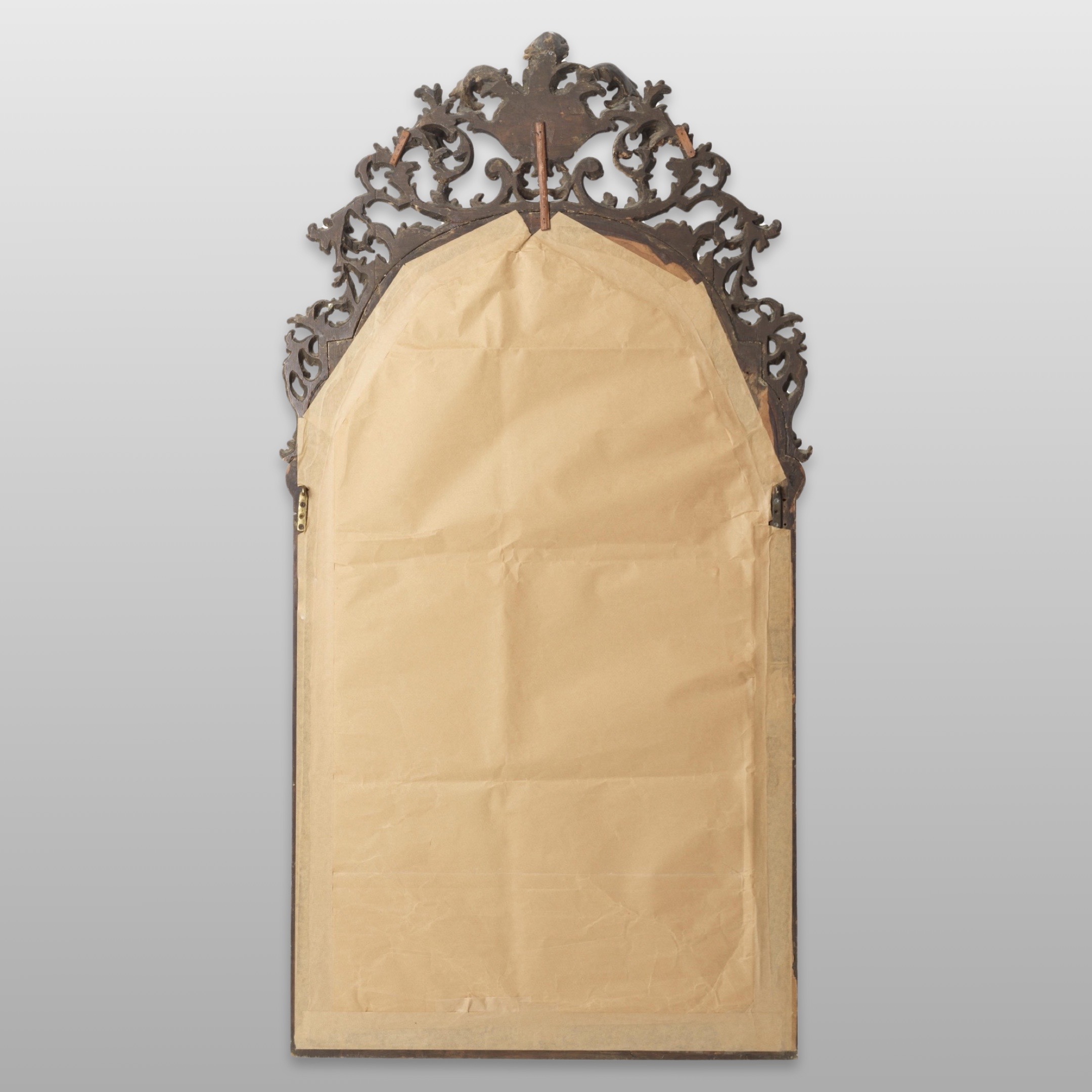
A exceptionally fine Queen Anne carved and silver-gilt pier mirror in the manner of Thomas and René Pelletier. The finely carved cresting formed of elaboratel foliate scrolls centred by an Earl’s coronet over an arched, bevelled plate encompassed by bevelled marginal plates mounted with ‘corners and middles’ of strap-work and leaf scrolls in carved and silver-gilt wood.
The dominant feature of the coronet tells us that the mirror was almost certainly commissioned by an Earl. The mirror largely retains its original silver-gilt surface which is a rare survival in itself as silver tended to tarnish and was in many cases subsequently gilded with gold leaf
Several comparable mirrors survive;
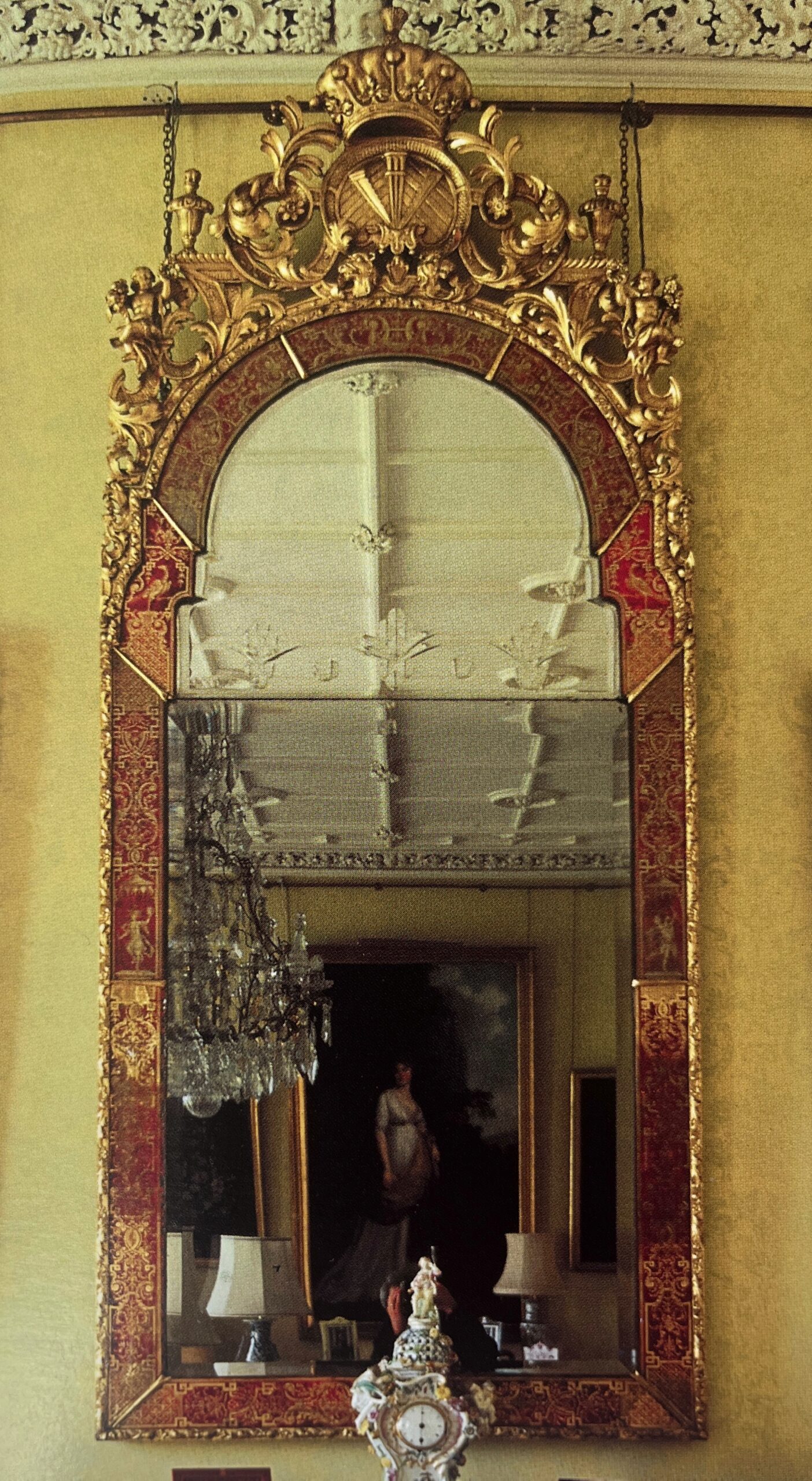
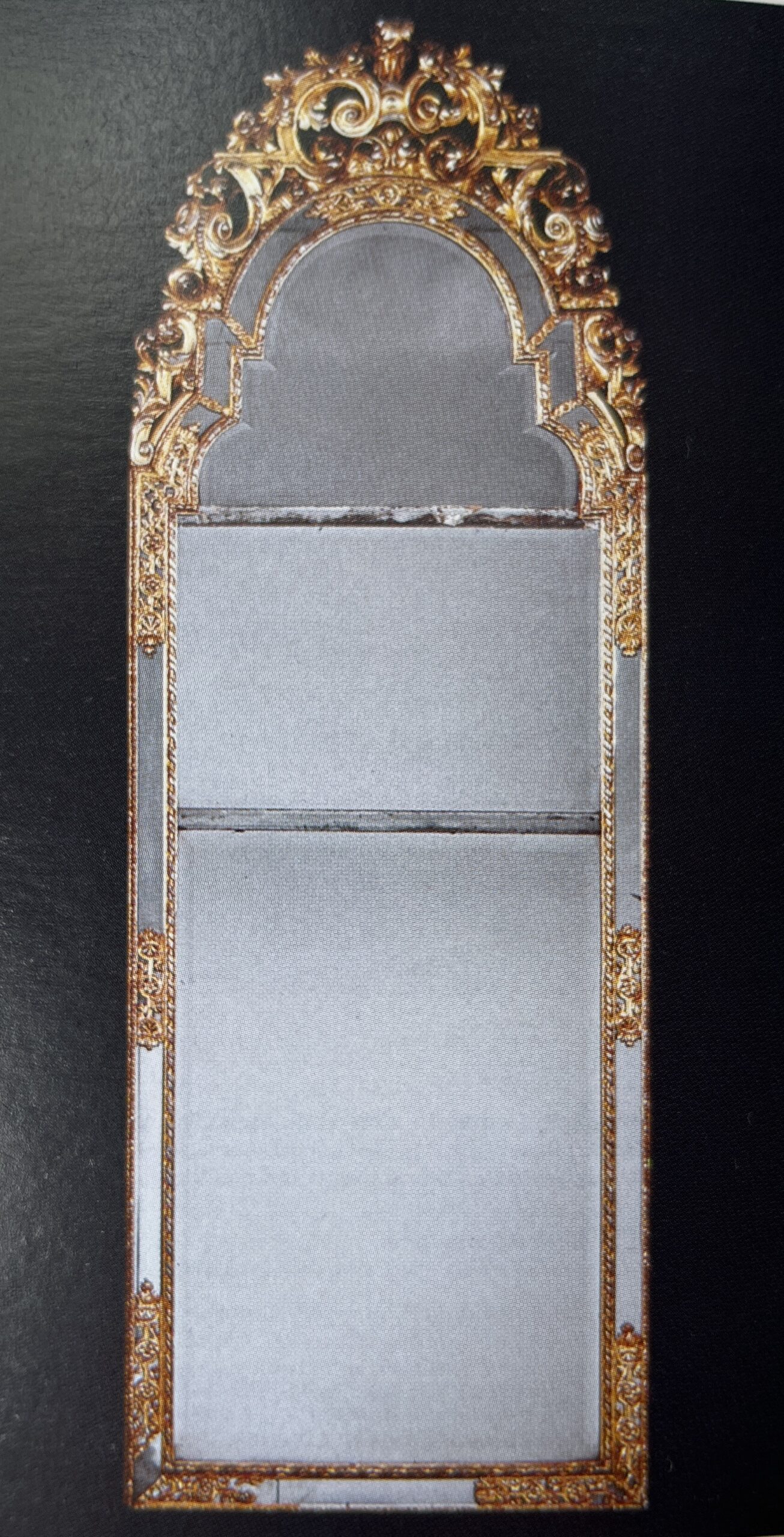
- The 6th Earl of Leicester commissioned a large giltwood and verre églomisé mirror, also featuring an Earl’s coronet to the cresting and which now hangs at Penshurst Place. (Illustrated)
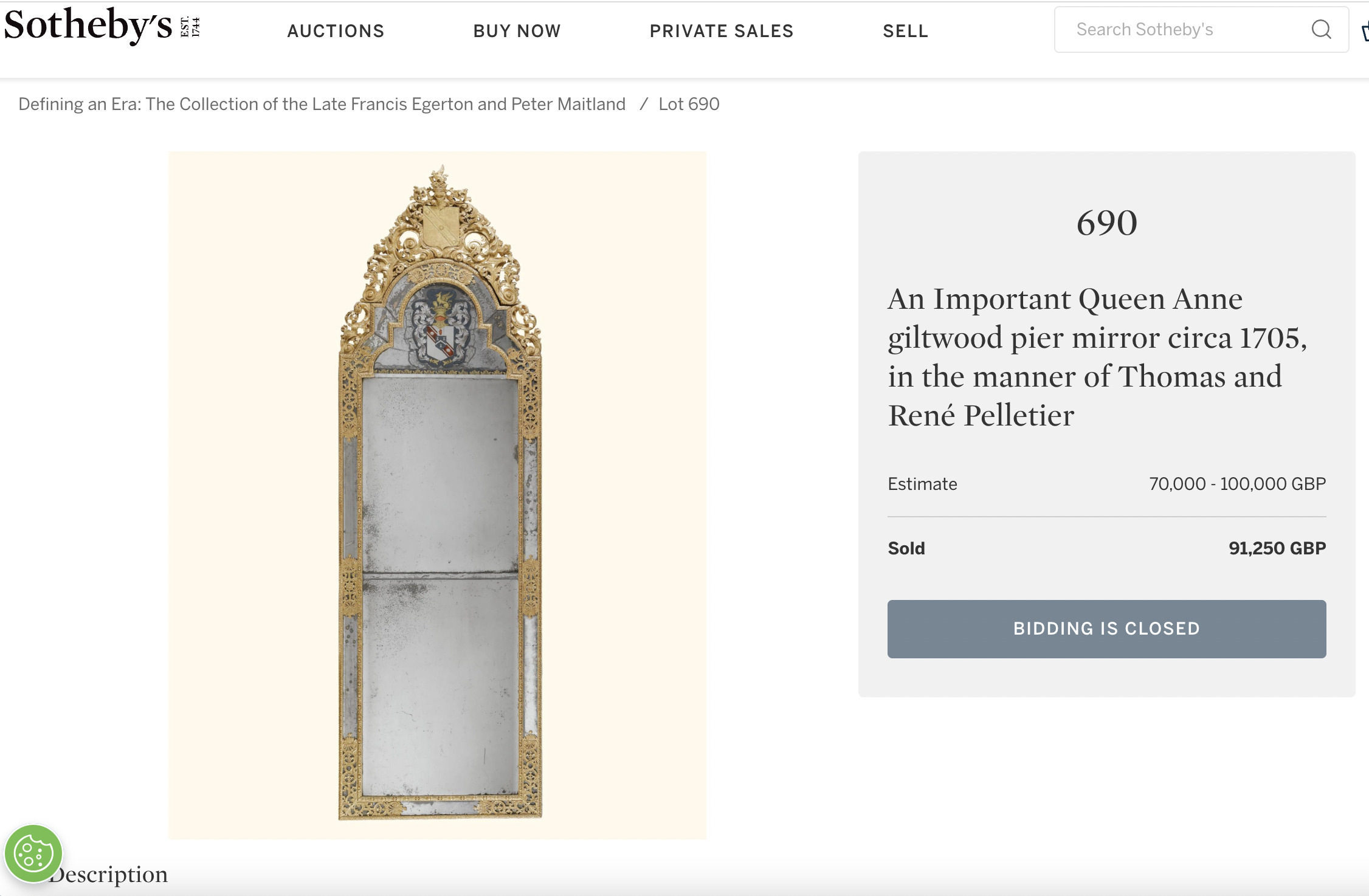
- Sothebys sold a pier glass with a similar arrangement of marginal and ‘corners and middles’ of strapwork from the Collection of the Late Francis Egerton and Peter Maitland, 28 April 2010, Lot 690 (Illustrated)
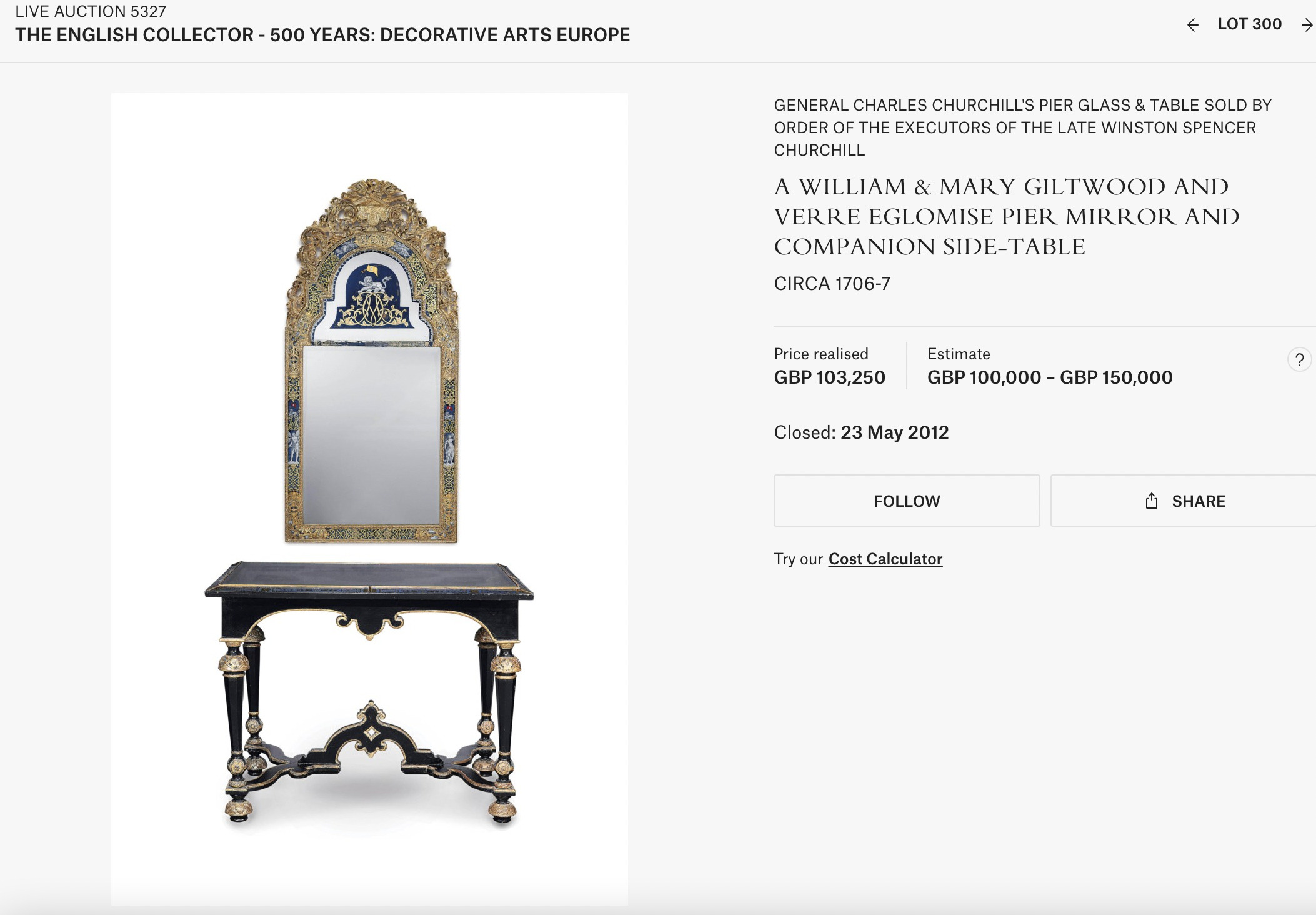
- The General Charles Churchill Pier Glass and Table were sold Christies, London, 23 May 2012, lot 300. The pier glass also featuring a similar cresting and arrangement of marginal and ‘corners and middles’ of strapwork (Illustrated)
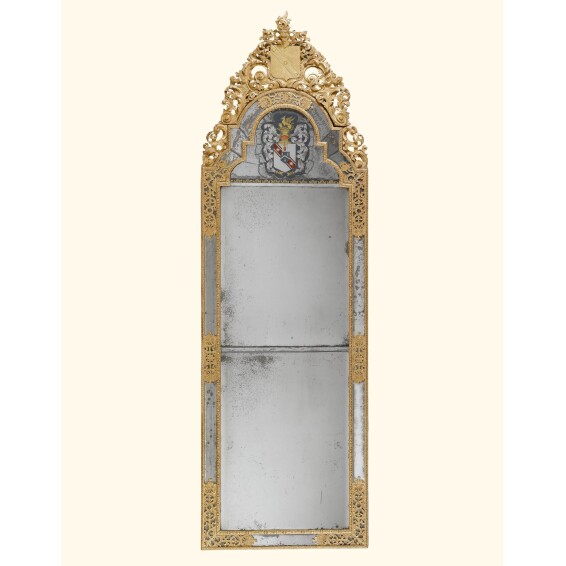
- Sothebys sold a pier glass with a similar arrangement of marginal and ‘corners and middles’ of strapwork (Illustrated)
Further examples (not illustrated):
Another pier glass of a similar date, originally supplied to Thomas, 1st Lord Coningsby, at Hampton Court, Herefordshire (cf. Ralph Edwards, The Dictionary of English Furniture, 2nd ed., 3 vols., vol. II, p. 234, fig. 33). The architect of Hampton Court, William Talman, was an associate of such eminent furniture makers as Gumley, Moore, Jensen and Pelletier, and it is possible that the present mirror, in common with that from Hampton Court, was produced by a member of this distinguished circle.
Another mirror of very similar design and size (274cm. high, 91cm. wide; 9ft, 3ft) sold Sotheby’s `The Moller Collection from Thorncombe Park, Surrey’, 18 November 1993, lot 46.
Without documentary evidence it is difficult to attribute the present mirror to a particular maker. However the form of the mirror and elements of the carving closely relate to a group of furniture including mirrors, associated with the late 17th/early 18th century style of carving, epitomised by the Paris-trained Pelletier family of carvers and gilders (see Tessa Murdoch, `Jean, René and Thomas Pelletier, a Huguenot family of carvers and gilders in England 1682-1726′, parts I-II, Burlington Magazine, November 1997 and June 1998). Thomas together with his brother René and father Jean left Paris for Amsterdam, after 1681, presumably to avoid persecution leading to the revocation of the Edict of Nantes in 1685. Jean is first recorded in England in 1681/1682 at which time he took out denization which gave him legal status as an English citizen. He was joined by first by his wife Esther and his younger son Thomas, soon afterwards. It is not known when René, the senior brother by ten years, left Amsterdam for London but he had possibly arrived by 1688 and certainly by 1691. The family were described as carvers and gilders, although in the late 17th century these skills were normally practiced by members of different guilds. In Jean’s will, drawn up in 1702, he is described as a `Frame Gilder’. After his death in 1704, he was described by his son René as a `Limner, Engraver and Gilder’. From 1689 until his death Jean’s principal patron appears to have been Ralph, Earl and later 1st Duke of Montagu. Montagu had been Charles II’s Ambassador to the Court of Louis XIV at Versaille, and was later appointed to the position of Master of the Wardrobe by William III. The furniture supplied by Pelletier for Montague House, Bloomsbury clearly reflects not only his Paris taught skills, but also his deep knowledge of the current fashions of the French Court of which Montagu himself was acutely aware and wished to emulate. Through Montagu’s influence Pelletier was granted a large commission to supply between 1699 and 1702 carved gilt wood furniture for William III’s State apartments at Hampton Court Palace. At a cost of some six hundred pounds, the commission included six tables with gilt wood frames supporting marble slabs flanked by pairs of large gilt-wood candle-stands. In the French manner, these were designed to be placed between the windows of the King’s Eating Room, the King’s Privy Chamber and the King’s Withdrawing Room.
Daniel Marot and his circle’s influence
Whilst this mirror is typically English in its attenuated proportions compared with French examples of the Regence period, it exhibits decorative characteristics which are influenced by the designs of the emigré Dutch Huguenot designer Daniel Marot and his circle. These are particularly evident in the applied carved ornament to the border glasses, incorporating palmette spandrels and the boldly scrolling strapwork. Such features are paralleled in a drawing of a table and pier glass by Marot dated 1701, for the palace of Het Loo, the house of Orange’s residence near Apeldoorn (see Peter Thornton, 17th century Interior Decoration in England, France and Holland, 1978, p. 45, pl. 51). Other related contemporary designs include a drawing for a chimneypiece surmounted by a mirror by Jean Bérain (1640-1711), Dessinateur de la Chambre du Roi, illustrated in J. de la Gorce, Bérain Dessinateur du Roi Soleil, Paris, 1986, p. 39. Philippe Poitou (1642-1709) who was appointed ébéniste, to the Duc d’Orléans circa 1700, supplied a number of ormolu mounted mirrors for the Duc at the Palais Royal or the Château de Saint-Cloud before 1724 which epitomise the aforementioned designs of Marot and his circle. A Louis XIV ormolu mirror, possibly by Poitou which has affinities with Marot and Bérain’s drawings and features palmette motifs to the corners, sold Christie’s London, 2 December 1997, lot 26 and another related mirror attributed to Charles Cressent who was an apprentice to Philippe Poitou, sold Christie’s Monaco, 4 December 1993.
Pelletier, René and Thomas
London; carver and gilders (b. c.1670–1726 and (b. c.1680-after 1726)
Thomas and René were the sons of Jean Pelletier, a French carver and gilder who received his letter of denization in London in 1682. According to a deposition in the Boughton archives, in 1712 René was then aged ‘40 years or thereabouts’ and Thomas ‘30 years or thereabouts’, which would make their birth years 1672 and 1682 respectively. But when René arrived in Amsterdam with his father in 1681, he was already working, since his trade of ‘engraver’ was noted when he applied for Amsterdam citizenship later that year. That being so it seems that René was probably born well before 1672.
It is assumed that the René and Thomas, with their mother Esther, came to England at the same time as their father (1682), although René may have continued working in Amsterdam for a while. However, he was certainly in England by 1691 when he stood godfather at the Huguenot Church on 5 July.
Both men later claimed to have worked with their father Jean from 1688 onwards, but it was Thomas who took over the management of the business from 1702. In November 1704, a month before his father’s death, Thomas was appointed Cabinet Maker in Ordinary to Queen Anne. However, no payments to Thomas Pelletier survive in the Great Wardrobe Accounts, and it has been suggested [Murdoch, 1998] that the carved giltwood furniture invoiced during Queen Anne’s reign by Gerrit Jensen was in fact made in Thomas Pelletier’s workshop. This includes three objects now in the Royal Collection: