





Rare Assyrian Revival Painted and Limed Oak Chair
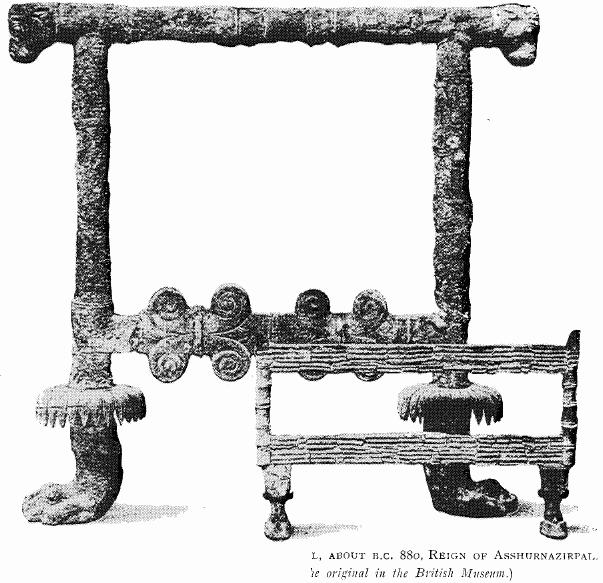
part of a bedroom suite (see appropriate entry for details of full suite), the cow-hide back and seat with leather clasps, the legs based on seat furniture in the Banqueting Scene Panel excavated at Nineveh (see footnote and illustration), the stretcher based on a bronze ceremonial throne excavated at Nineveh (see footnote and illustration)
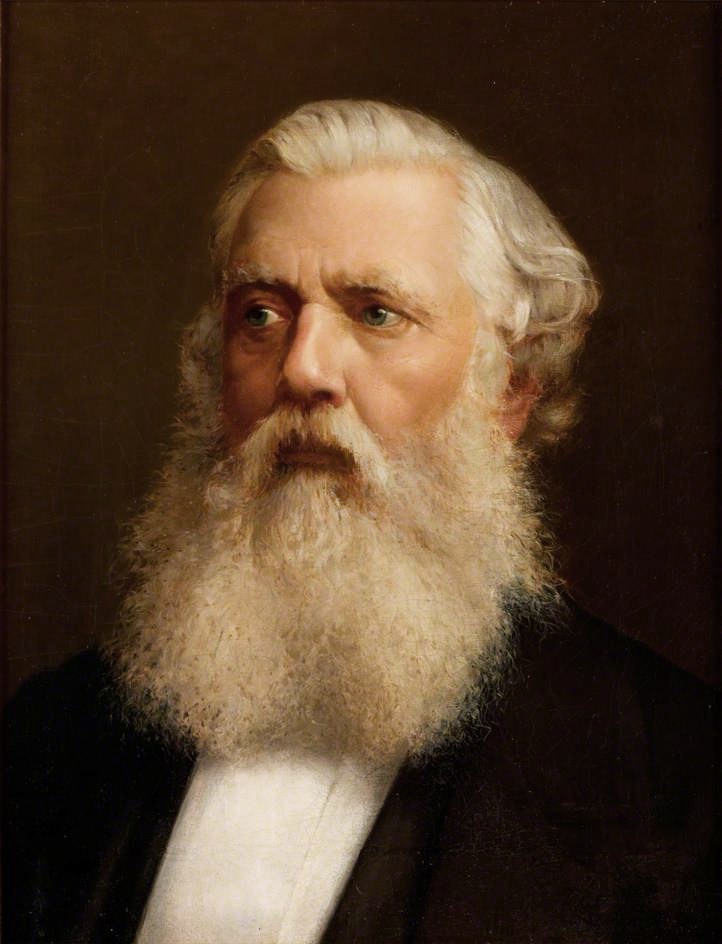
The Apkallu figures on the wardrobe and side-cabinet are inspired by a panel in the British Museum excavated at Nimrud in Upper Mesopotamia in the mid 19th century. The basic inspiration for the legs and feet seems to come from the so-called Banquet-Scene Panel in the British Museum, excavated at the North Palace of Nineveh, also in the mid 19th century. The inspiration for the stretcher of the chair and stool comes from a ceremonial bronze throne excavated at Nineveh in the mid 19th century and drawn by Austen Henry Layard who first excavated there. Two portraits of Layard are here included, one as a young man sketching at an archaeological dig, and one with flowing beard in old age, when he was a trustee of the British Museum, which had given a home to so many of the extraordinary artefacts he had found, some of which inspired the present suite.
Stylistically this suite would seem to date from the late 19th century, and it is tempting to surmise that it might have been designed by Austen Henry Layard (1817-1894), archaeologist, architect and polymath, who first excavated at Nineveh, perhaps for his house at 1, Queen Anne Street, Marylebone, and was then acquired, after his death, by Frank Salisbury (see below). There was a huge resurgence of interest in Mesopotamian archaeology when the British Museum re-opened the excavations at Ur in 1918, which might have proved the inspiration for its manufacture, though stylistically the suite feels earlier than this
Two pieces have labels from Allen’s Depositories naming the owner as Francis ‘Frank’ Owen Salisbury (1874-1962) who, from inauspicious beginnings, became one of the most successful portrait artists of the first half of the 20th century. Nicknamed ‘Britain’s Painter Laureate’, he therefore certainly owned the suite. In his early years he showed great facility with the brush and his brother paid for him to attend Art School. This facility stood him in good stead and he produced portraits of many of his worthy contemporaries on both sides of the Atlantic – he was also adept at portraying scenes of magnificent pageantry and sweeping historic events. In the early 1900s he built a house and studio, Red Gables in Harpenden and, depending on when he acquired the suite, this is probably where he first housed it. In 1932 he was able to build himself a huge house at the top of Telegraph Hill (where, he was proud to record, the first Armada beacon was lit) in Hampstead. Sarum Chase, built in the Neo-Tudor manner, had interiors which seem to have been furnished with rather an historical mish-mash of styles, described by Pevsner as ‘pure Hollywood Tudor’, and has subsequently been used to great effect in several horror films. Whilst Sarum Chase was being built, Salisbury rented a property at 62, Avenue Road, Swiss Cottage, and this is the most likely period for his chattels to have been in storage. On his death, Salisbury left Sarum Chase to the British Council of Churches, who lost no time in auctioning off the contents and selling the building. Towards the end of his career, at the age of seventy, Salisbury painted a series of pictures of The Prophets – Daniel, in a suspiciously Egyptian looking Babylonian temple, and Amos seemingly in Assyria, though he’s not recorded ever visiting that country (he did prophecy the fall of Israel, though not specifically to Assyria). F. O. Salisbury’s knowledge of archaeological (not to say biblical) history seems to have been tenuous at best.
Frank Salisbury must have either given or left the suite to his daughter, Monica (here illustrated), who married Mr. Leonard Norris as there is a chalk inscription to the back of the wardrobe, Mr. Norris.