


16th century Tudor Oak Doorway or Overdoor
£28,500
An exceptional 16th century Tudor doorway of museum grade. Made for the Wynn (Winn) family during the reign of Henry VIII 1538.
The breakfront pediment above a horizontal panel relief carved with renaissance interlaced foliage and dragons, having two sidesmen supporting a cartouche with central merchant’s mark having inversed initials ‘M W’ for Maurice Wynn, c.1520-1580, flanked by acanthus carved brackets.
Above a larger tympanum shaped panel with deep arcade, carved in high relief with a pair of Centaurs supporting an armorial of a crowned maiden on a base of lilies, being the symbol of the Mercers Company, further flanked by a pair of inset Tudor roses. Inscribed and dated in raised gothic script lettering ‘ANNO ~ DOMINI ~ 1538’. The door aperture with spandrel brackets to the arch carved with male and female heads set within a cornucopia of trailing foliage, all flanked by renaissance pillars elaborately carved with spirals, leaves, lancet crosses, pomegranates and fluted tracery. With a natural, dry patination.
Provenance:
Purchased from Nostell Priory, Wakefield, Yorkshire. Christie’s auction on instruction of the Winn family, 30 April – 1 May, 1990.
Nostell Priory was purchased by the Wynn’s (Winn) of Gwydir Castle, Wales, in 1654. They had made their fortune in the fabric trade in London in the Tudor period.
Nostell was a partially converted Priory after the reformation with later 16th and 17th century additions, it was this property and land the Wynn’s acquired.
The Christie’s auction in 1990 consisted of furniture and furnishings from over four centuries, including a great tester Bed made for the second Baronets second marriage in 1673.
In the immediate grounds close to the house is the late medieval church of St Michael and Our Lady, Wragby, the local parish church. Within it are various Tudor and renaissance interior fixtures and fittings in Oak that were installed by the Wynn family.
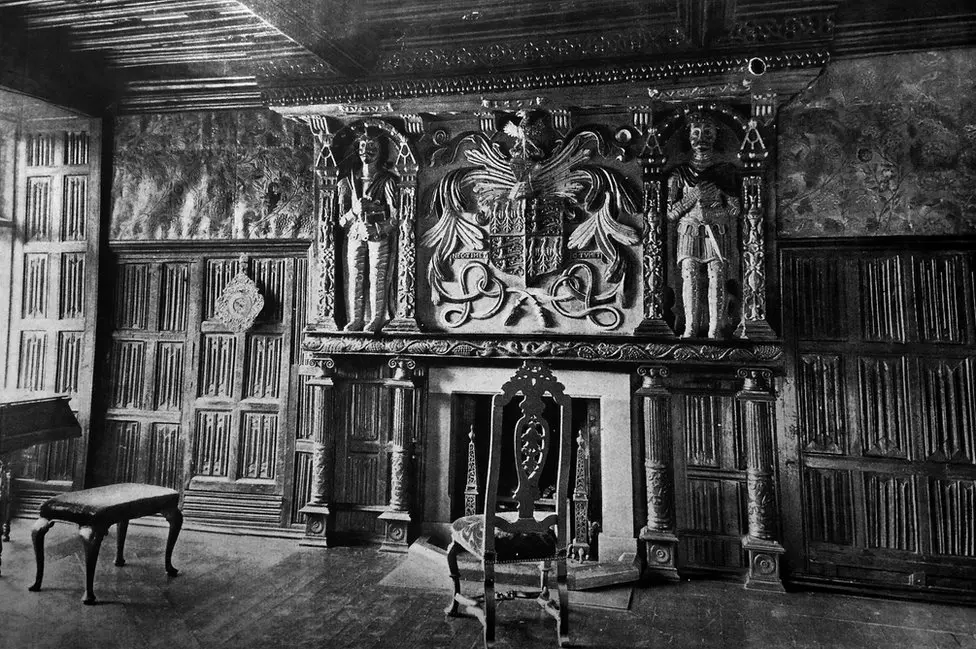
This Overdoor appears to never have been installed within Nostell nor was it used in the Church. Having the merchants mark of Maurice (Morris) Wynn, plus the Mercers Company armorial on the overdoor strongly suggests it was brought with them from one of the other Wynn properties. Whether it was from the family seat at Gwydir or their London property linked to the fabric trade is presently not known. Gwydir, called Castle but really a fine example of a fortified Manor House, certainly had elaborate oak panelling installed in the 16th century, see photo of the Oak Parlour, purchased by William Randolph Hearst in the 1930s and present whereabouts un-recorded. The presence of the Mercer’s arms on the offered doorway, and the fact that the Gwydir estate passed out of the Wynn family in 1678, perhaps makes it more likely that this element came from the London residence of the Wynn family. It must have gone up to Nostell Priory some time after 1654, when Sir Rowland Winn bought the estate and, perhaps, when their London House was dismantled and might have been installed in the priory/residence there prior to its re-building to designs by James Paine in the 1730s.


