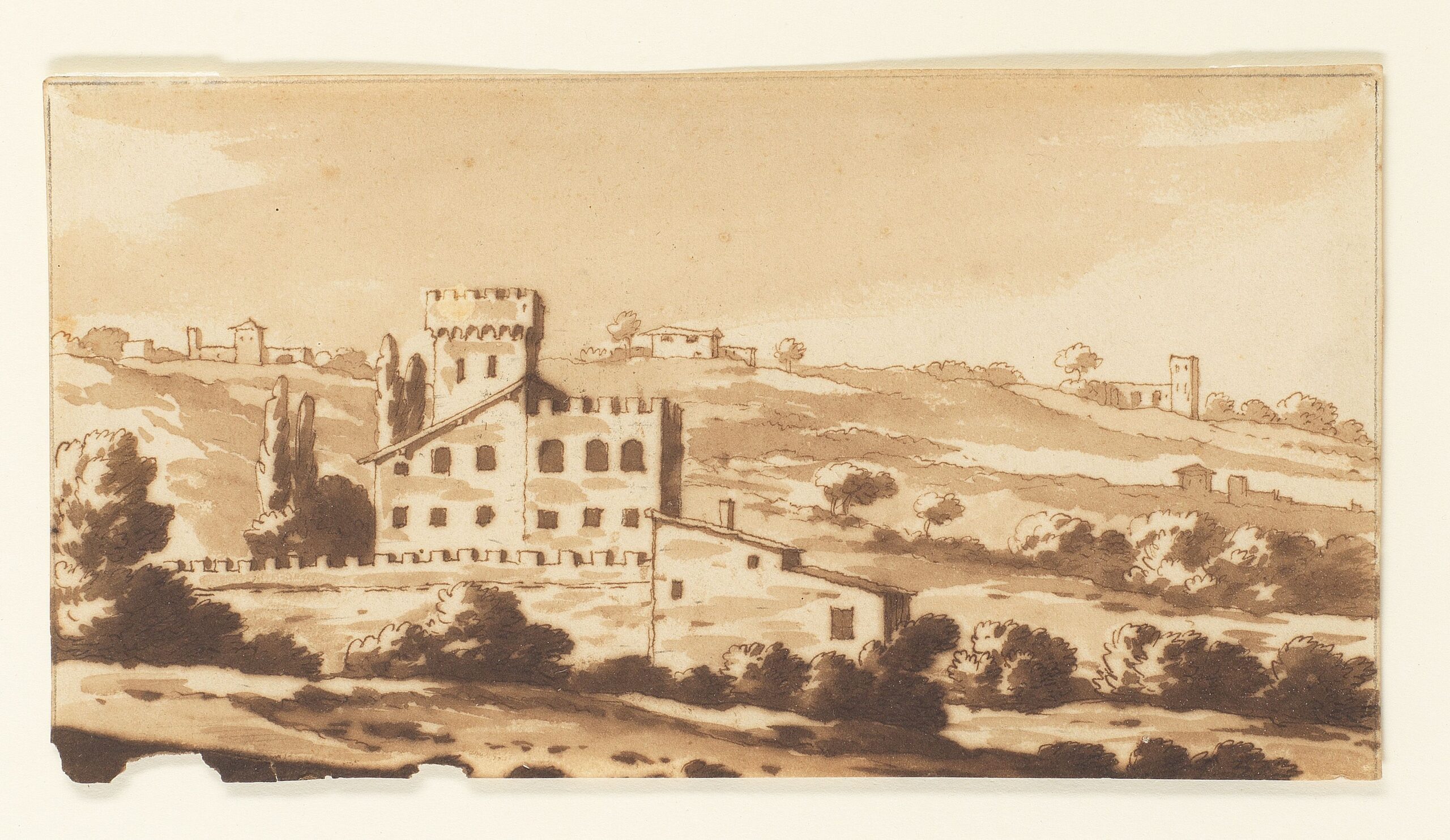


Jacob Van Der Ulft: Buildings near the Acqua Acetosa, Roman Campagna
£1,250
A view of the same scene is to be found in the collection of the Chatsworth Settlement (here illustrated)
Jacob Van Der Ulft (Gorinchem 1627-1689 Noordwijk)
Jacob van der Ulft was a dilettante draftsman. He was the burgomaster of Gorkum, in the Netherlands, from 1660 to 1679. Although he never went to Rome he depicted numerous Roman and Italian views. His sources of inspiration were the prints and drawings of a fellow dilettante draftsman: Jan de Bisschop. The two men may have worked together, but it is also possible that van der Ulft acquired many of de Bisschop’s drawings at auction in 1677 (see P. Schatborn, Drawn to Warmth. 17th Century Dutch Artists in Italy, exhib. cat., Amsterdam, Rijksmuseum, 2001, pp. 196-199). Most of der Ulft drawings, like the present sheet, are in pen and ink, brush and wash. The view depicted here appears to be an imaginary assemblage of Roman buildings rather than a real site.
Paintings by Van der Ulft are quite rare and can be found in some of the world’s leading museums, including the Rijksmuseum, Amsterdam, the Frans Hals Museum, Haarlem, the Hermitage, St-Petersburg and the Mauritshuis, The Hague, which holds his Italianate Landscape with an Advancing Army of 1671 The artist was an active draughtsman, and a considerable number of drawings by him has survived, including works in the Herzog Anton Ulrich Museum in Braunschweig, the Teylers Museum, Haarlem, the Pushkin Museum, Moscow, the Huntingdon Library, San Marino and the Weimarar Klassik und Kunstsammlungen, Weimar.
Although Van der Ulft is likely to have drawn for his own amusement, something like an amateur, ‘painterly’ drawings such as this sheet were also eagerly acquired by contemporary collectors of ‘papierconst’.
Provenance:
Nonesuch Gallery, London
(View of a castle in Italy, sold at Beaussant-Lefèvre, Paris, 11.02.2022, Lot 284) (here illustrated).
. Van der Ulfe’s
oeuvre comprised paintings in oil and gouache, as well as a large number of drawings like the present work, many of which are closely related to those of Jan de Bisschop, who had learned to draw from Bartholomeus Breenbergh. Indeed, many are actually direct copies after de Bisschop’s