


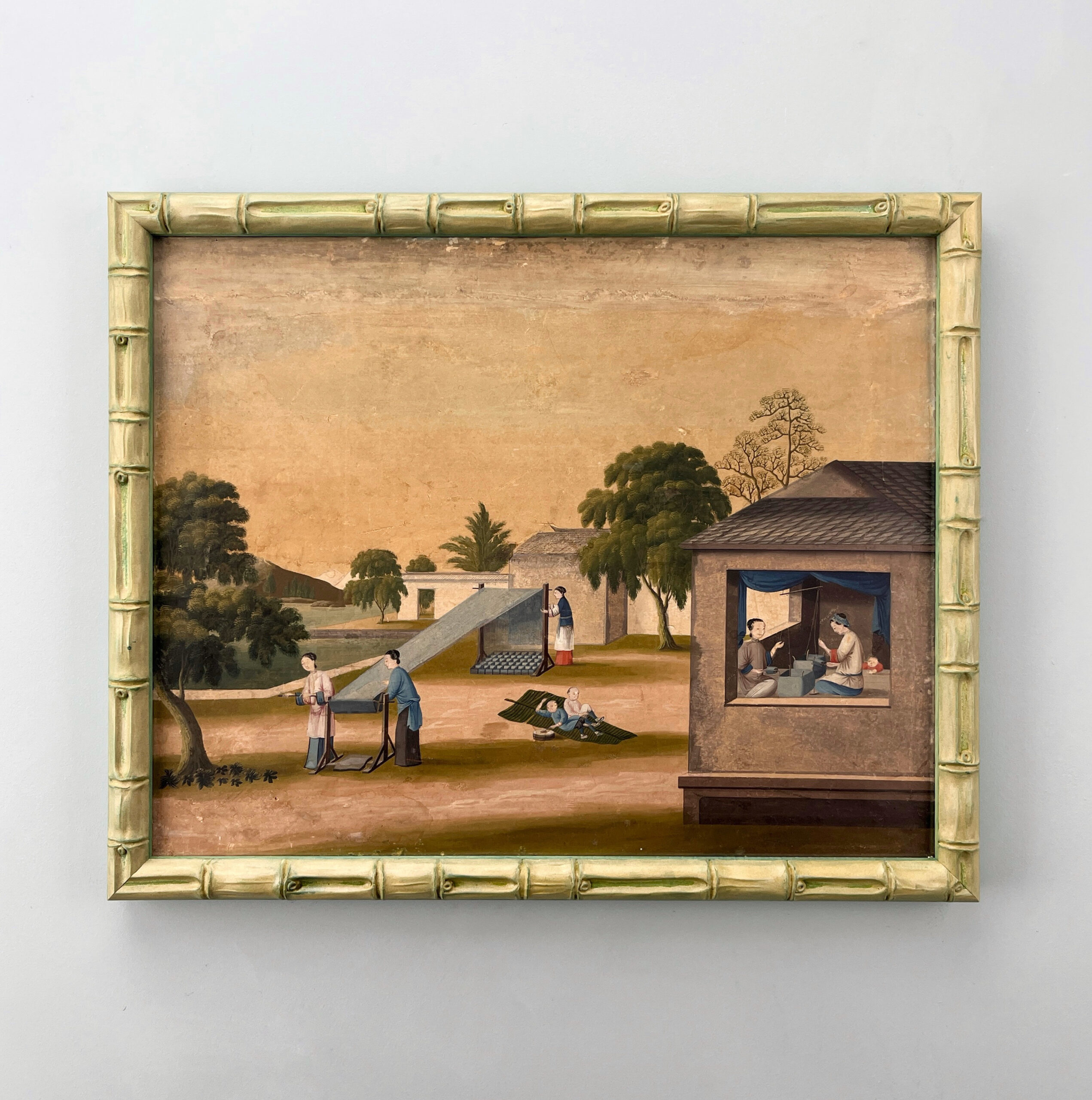


Rare Set of Eight Antique Chinese School Gouaches Paintings of Silk Production (Sericulture)
A rare set of eight Chinese school paintings of silk production (Sericulture), showing the various stages of production, including gathering the silkworm eggs, boiling cocoons, reeling silk thread and the selling of the final product. Gouache on paper laid onto board; contained in later painted faux bamboo frames
Watercolours depicting the growing and processing of tea, the making and decoration of porcelain, the production of silk and cultivation of rice, were put together in sets of sheets … These subjects were immensely popular in the last quarter of the 18th and first quarter of the 19th century, since they explained to the westerner, in a most imaginary, glamorous and unrealistic manner, the making of products sent to the west. The most desired watercolour in a series was the one which depicted a western merchant or supercargo in a wonderful period dress negotiating with Chinese merchants. These watercolours depicting crafts and manufacturing processes varied in complexity, in composition and detail, but the finest became some of the most sought after items of the export trade. Dating these series can prove tricky, as these early sheets were used as models for generations of copies in the first half of the 19th century, most notably those fine but later sets of sheets painted by artists in Tingqua’s studio in the 1830s-1850s. ‘Those subjects which were obviously customers’ favourites were repeated again and again… This composition hardly changed from one studio to another, but the European merchant’s costume was updated from time to time… mention has been made of the possible use of a printed outline from a woodblock to facilitate production by the artist and his assistants.’ (M. Gregory, ‘Tingqua’s China’, Martyn Gregory, 1986, unnumbered cat., p.7).
Silk was, with tea and porcelain, one of the main Chinese exports. It had been exported as early as the late 13th and early 14th centuries, as well as being one of the staples of the Canton export trade in the 18th and 19th centuries.
The Chinese artists traditionally painted in watercolour, bodycolour and tempera on silk, and produced the first export views of Canton and the Pearl River on silk in the 1750s and 1760s, before they began to work on stocks of imported papers. These were more often than not Whatman paper from Kent, more resilient a support than silk (and Whatman’s wove papers particularly suited to the humid airs of southern China). The Cantonese artists added oils on canvas to their repertoire from around the 1770s, as the supply of western materials, and demand for paintings, grew.