

A Rare George III Satinwood and Yew Wood ‘Harlequin’ Commode
£3,850
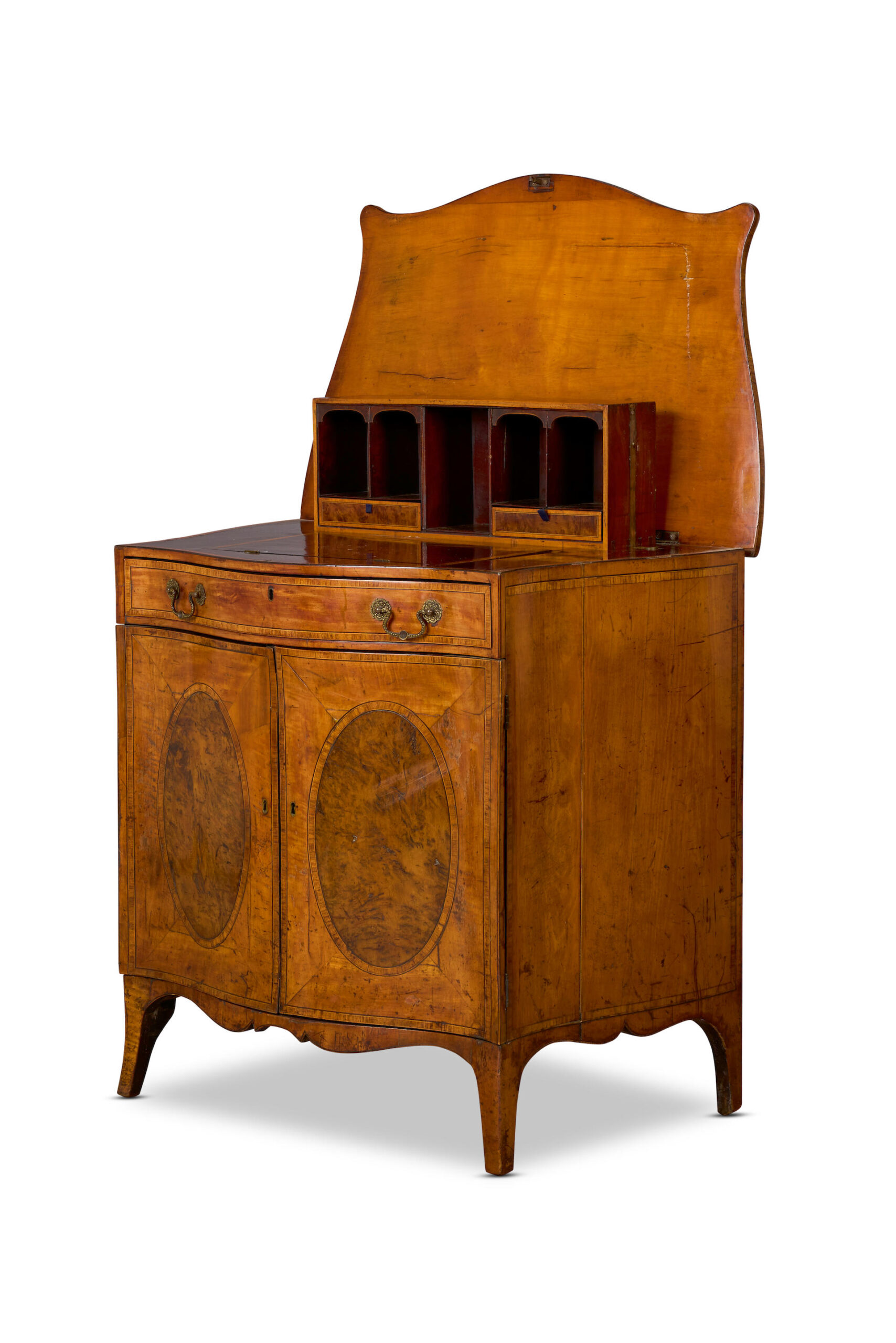
A rare George III satinwood, burr yew and tulipwood crossbanded serpentine ‘harlequin’ writing/dressing commode with ebonised and boxwood stringing, the quarter segmented top inlaid with a central oval, opening to reveal a mahogany and fruitwood banded surface inset to the rear with a catch-activated and concealed pop-up superstructure comprised of four arched pigeon holes and two short mahogany lined drawers flanking a central open compartment, with a hinged adjustable ratcheted surface to the front, over one long mahogany lined frieze drawer, enclosing a central open compartment flanked by two hinged lidded compartments, over a pair of quarter segmented doors with oval tablet inlays of burr yew, enclosing four long graduated beech lined drawers, with a shaped apron below raised on splayed feet
This ingenious commode, which mechanically transforms itself from a conventional commode into a reading and writing commode or, indeed, an ingenious place to conceal valuables and private documents, is in the manner of Henry Kettle (1773-1797), cabinet maker and upholder (upholsterer), of 18 St. Paul’s Churchyard, London, and from 1774, no. 23, when Kettle took over the business of Philip Bell.
A comparable piece of Harlequin furniture is a satinwood and burr yew Pembroke table also in the manner of Henry Kettle, also circa 1785, which sold Christie’s, London, 19 January 2021, Apter-Fredericks: 75 Years of Important English Furniture, lot 48.
Height 87 cm (34.25 inches)
Width 89 cm (35 inches)
Depth 58 cm (22.75 inches)
Circa 1785